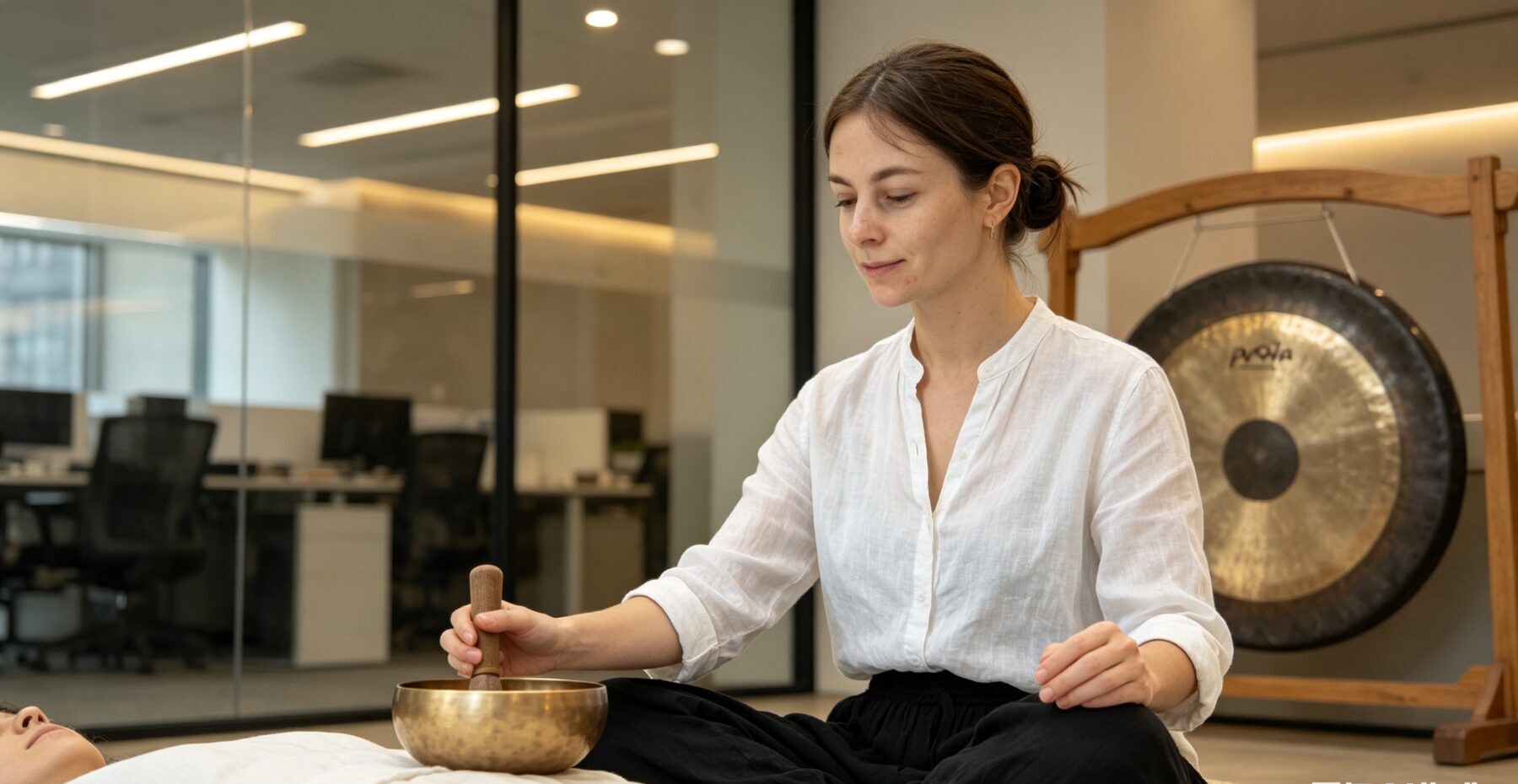
If someone had described a "sound bath" to me a few years ago, I probably would have pictured something abstract — people lying in a room while someone plays instruments nearby. And yes, that is essentially what it is. But the experience itself is something quite different from what that description suggests.
A sound bath is one of the most accessible, deeply restful experiences you can have. No meditation experience required. No special breathing technique to learn. You simply lie down, close your eyes, and let the sound do its work.
In this article I want to explain what actually happens during a sound bath — the practical side, the science behind it, the benefits people experience, and what you might feel during and afterwards. Whether you're curious and haven't tried it, or you've had one session and want to understand it better, this is written for you.
What actually happens in a sound bath?
You lie down fully clothed on a mat or blanket — sometimes with an eye pillow — and the practitioner begins to play instruments around you. The most common instruments are Tibetan singing bowls, crystal singing bowls, and gongs. In my sessions I use Tibetan bowls and gong, sometimes with additional instruments depending on what the session calls for.
There's no talking during the sound itself. No guided visualisation (unless you want it). The session usually begins quietly — with a short check-in, some simple breathing guidance, and then the sound starts gradually. It builds. It moves around the space. It settles. By the end, most people are in a state somewhere between light sleep and deep relaxation — what's sometimes described as a theta brainwave state.
A standard session lasts between 50 and 90 minutes. The sound portion is usually 40–60 minutes, with time before and after for settling in and integrating.
"Most people are surprised by how deeply they rest — and how quickly it happens."
Why does sound have this effect on the body?
This is where it gets interesting. Sound works on the body not just through the ears, but through vibration — you feel it as much as you hear it. When Tibetan singing bowls or gongs are played near the body, the vibrations travel through the air and through the physical tissues, affecting the nervous system directly.
A few things happen on a physiological level:
- Brainwave entrainment: The sustained, repetitive frequencies of singing bowls encourage the brain to shift from its usual active beta state into slower alpha and theta states — the states associated with deep relaxation, creativity and the threshold of sleep.
- Nervous system regulation: Sound activates the parasympathetic nervous system (the rest-and-digest response), which counteracts the chronic stress state many people live in. Heart rate slows. Breathing deepens. Muscle tension releases.
- Cortisol reduction: Research has shown that sound meditation can reduce cortisol levels — the primary stress hormone — measurably after a single session.
- Vibration in tissue: The physical resonance of bowls placed near or on the body creates a kind of internal massage effect — particularly felt in the chest, abdomen and head.
None of this requires belief or prior experience to work. The body responds to sound the way it responds to temperature or touch — automatically.
What the research says
A 2016 study published in the Journal of Evidence-Based Complementary & Alternative Medicine found that participants who attended a Tibetan singing bowl meditation reported significantly lower tension, anger, fatigue, and depressed mood compared to the control group. The effect was particularly pronounced in participants who were new to the practice.
A 2020 study found that a single sound healing session produced measurable reductions in anxiety and physical tension, with effects lasting beyond the session itself.
What does a sound bath feel like?
This varies from person to person, and even from session to session for the same person. But here are the things I hear most often from people after their first experience:
- "I didn't think I fell asleep, but I must have" — the theta state feels like the edge of sleep without quite crossing into it. Time distorts.
- "I felt the sound more than I heard it" — especially with gong, the vibration is physical. Many people feel it in the chest or stomach.
- "My mind went quiet for the first time in weeks" — this is one of the most consistent reports. The sound gives the mind something neutral to rest on.
- "I felt emotional, and I didn't expect that" — sound can move stuck emotion. This isn't unusual. It's gentle and safe, but it's real.
- "Afterwards I felt heavy and light at the same time" — deeply rested but present. Like after a long massage.
Some people see colours or images. Some feel tingling in the hands or feet. Some simply drift and rest. There is no correct experience — what happens is what your system needs.
What are the main benefits of a sound bath?
Based on both research and the consistent feedback I receive from clients, the most common benefits are:
Better sleep
Many people notice improved sleep in the days following a session. The nervous system reset that happens during a sound bath carries over — it's easier to fall asleep, stay asleep, and reach deeper stages of rest. For people who wake at 3am or lie awake with a busy mind, this can be significant.
Stress and anxiety relief
A sound bath gives the nervous system a genuine rest — not just distraction, but actual physiological downregulation. People who carry chronic stress often describe feeling "reset" afterwards. The effect isn't permanent, but it's real, and it compounds with regular sessions.
Emotional clarity
Sound can help shift emotional states that feel stuck. This isn't about processing trauma — it's more subtle than that. A heavy week can feel lighter after a session. A decision that felt clouded can feel clearer.
Physical release of tension
Particularly in the neck, shoulders and jaw — areas where most people carry stress unconsciously. The vibration of bowls near these areas, combined with the parasympathetic response, allows muscles to release in a way that's hard to achieve through willpower alone.
A genuine mental reset
In Hong Kong especially, where the pace of life is relentless and switching off is genuinely difficult, a sound bath offers something rare: a full hour of uninterrupted quiet for the nervous system. Not meditation (which takes practice). Not sleep (which can be disrupted by stress). Something in between — accessible to almost anyone.
What's the difference between a sound bath and a gong bath?
The terms are often used interchangeably, but there's a practical distinction. A gong bath refers specifically to a session where gongs are the primary instrument. Gongs produce a broader, more complex wave of sound — almost like an ocean of vibration. They tend to create a deeper, more immersive experience and can be quite intense for first-timers.
A sound bath is the broader category and can include singing bowls (Tibetan or crystal), gongs, tuning forks, drums, harps, or a combination. A typical private session with me uses Tibetan singing bowls as the main instrument, with gong introduced later in the session once the nervous system is already settled.
Tibetan singing bowls tend to feel softer and more intimate — particularly well-suited for private or one-to-one sessions. Crystal singing bowls have a brighter, more piercing tone. Each has a different quality and different people resonate differently with each.
Is a sound bath the same as meditation?
Not exactly, though the two overlap. Traditional meditation requires active attention — you observe thoughts, return to the breath, maintain awareness. It's a practice, and it takes time to develop.
A sound bath is more passive. The sound carries you. You don't need to do anything except lie still — the nervous system shift happens whether or not you're "trying". This is why it works so well for people who struggle with meditation, or who find their mind too busy to settle on their own.
That said, regular sound bath experiences can make meditation easier. Many clients who begin with sessions start to develop their own sitting practice as a result, because they've experienced what a quiet mind actually feels like.
"You don't need to do anything except lie still. The sound carries you."
Who is a sound bath suitable for?
Almost everyone. There are very few contraindications. It's non-invasive, non-pharmaceutical, and requires no physical ability or prior experience. In my practice I work with:
- People dealing with stress, anxiety or burnout
- People with sleep difficulties — insomnia, early waking, difficulty switching off
- People going through periods of transition — career change, relationship shifts, grief, physical recovery
- Women navigating hormonal cycles, perimenopause or postpartum recovery
- Couples and close friends looking for a shared experience of rest
- Corporate teams needing a genuine reset between demanding periods
- People who are simply curious — no reason needed
The main caution is for people with certain medical implants (metal plates, pacemakers) where vibration near the body may be inadvisable, and for people in the acute phase of certain mental health conditions. If in doubt, check with your doctor — and feel free to reach out to me before booking if you have specific questions.
How often should you do a sound bath?
This is one of the questions I get asked most. There's no fixed prescription. Here's how I think about it:
- First session: Simply to experience it, with no expectations.
- Monthly: A consistent reset — like a deep massage for the nervous system. Good for maintenance.
- More frequently during high-stress periods: Some clients come every two weeks when they're going through something demanding. Others come before or after major events — a big work presentation, a difficult conversation, a period of grief.
The effects do compound. Regular sessions tend to make it easier to access deeper rest, and many clients report that they sleep better overall after committing to monthly sessions over a few months.
Frequently asked questions
Do I need to do anything to prepare?
Nothing specific. Wear comfortable clothes. Avoid a heavy meal in the hour before. That's it. You don't need to meditate beforehand, clear your mind, or arrive in a particular state — the session takes care of that.
What if I fall asleep during the session?
This is completely fine. It happens often. The benefits still occur — in some ways, if you fall asleep it means your nervous system needed exactly that. You'll be gently guided back at the close of the session.
Will I feel emotional?
You might, and that's okay. Sound can release emotional tension that's been held in the body. It's gentle, not jarring. If you feel something rising, you can simply let it be — there's nothing you need to do with it. Integration time at the end of the session gives you space to settle.
How is a private session different from a group sound bath?
In a private session, everything is tailored specifically to you — the instruments used, the pace, the length, the focus. There's a check-in before, so I understand what you're working with. In a group setting, the experience is shared and less personalised, though still beneficial. Most people find the private format significantly more effective, particularly for the first experience.
How long does the effect last?
This varies. Most people notice a calmer quality for one to three days after a session — better sleep, less reactive, more patient with themselves. With regular sessions, this baseline tends to shift over time.
Where do sessions take place in Hong Kong?
Sessions are held in a private rooftop setting in Central Hong Kong from September to May, and in a private indoor space from June to September. Both settings are quiet, private and fully set up for the experience.
Experience it yourself
Book a Private Sound Bath in Hong Kong
Sessions for 1, 2 or small groups in Central Hong Kong. From HKD 1,080. Private rooftop setting available September–May.
More from Kate Sound Studio
If this article was useful, you might also enjoy: